Notes


Notes - notes.io |
# How Small Businesses Are Using AI to Scale in 2026
AI is helping small businesses tackle challenges like limited budgets, labor shortages, and rising costs by automating repetitive tasks, improving efficiency, and boosting growth. In 2026, nearly all small businesses (98%) are using AI daily, with 91% crediting it for growth and 87% reporting operational improvements. Whether it's automating customer support, optimizing marketing, or managing finances, AI tools make it easier to compete and grow.
Key takeaways:
- **Marketing**: AI automates campaigns, personalizes customer interactions, and improves engagement. Tools like [HubSpot](https://www.hubspot.com/) and [Jasper AI](https://www.jasper.ai/) save time and increase revenue.
- **Customer Support**: AI chatbots handle routine queries 24/7, reducing costs and improving response times.
- **Operations**: AI streamlines workflows, manages inventory, and automates tasks like data entry and scheduling.
- **Financial Planning**: Predictive analytics help businesses forecast cash flow, manage risks, and identify growth opportunities.
Small businesses are starting small, focusing on high-impact tasks, and scaling AI use as they see results. With accessible tools and clear ROI, AI is no longer a luxury - it’s a practical way to stay competitive and grow.
::: @figure 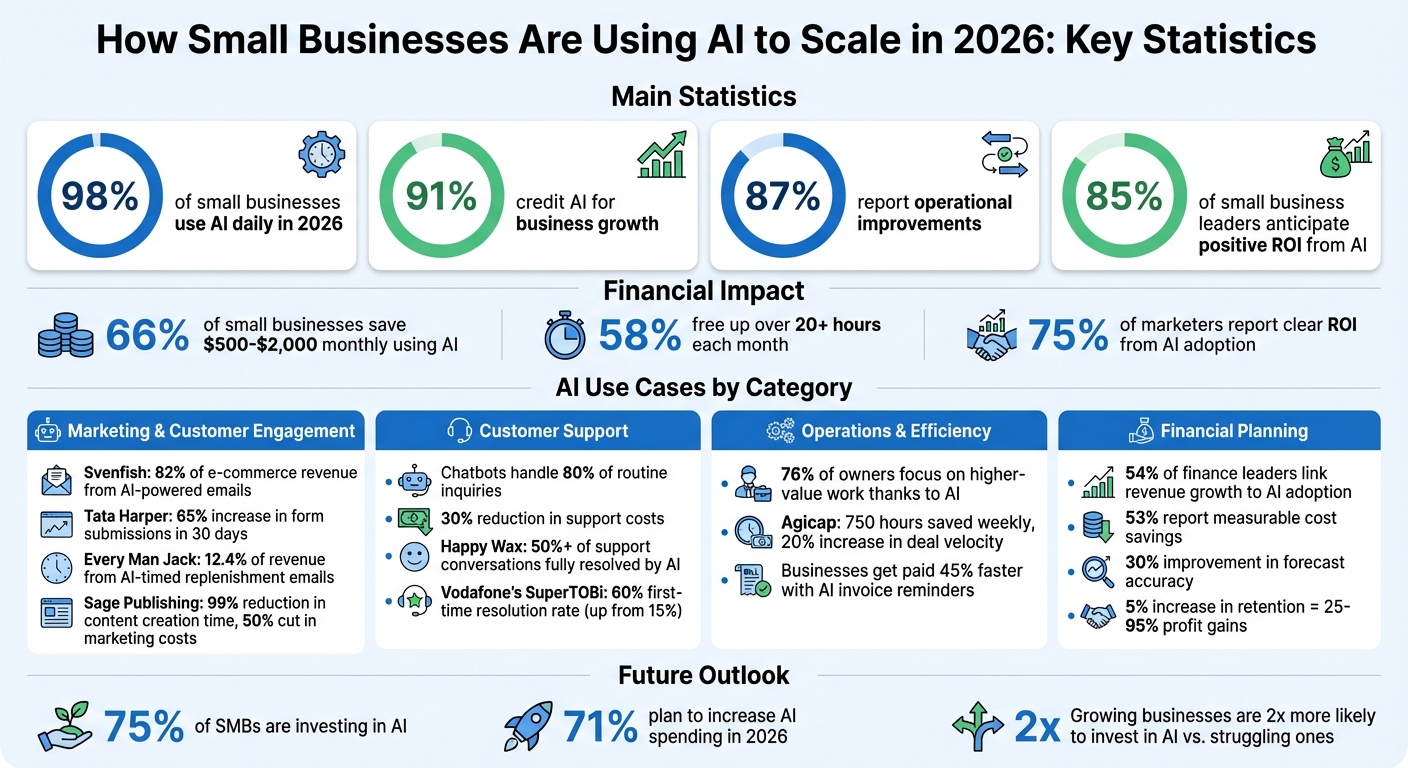AI Adoption Statistics for Small Businesses in 2026
:::
## How To Use AI to Start, Build & Grow Your Small Business (20 AI Marketing Tools!)
::: @iframe https://www.youtube.com/embed/nkuPUJVzB_E
:::
## AI for Marketing and Customer Engagement
Marketing used to mean juggling between handling everything yourself or hiring a pricey agency. Now, AI tools are leveling the playing field, allowing small businesses to compete with larger brands by automating campaigns, responding to customers instantly, and tailoring interactions to individual preferences.
### Marketing Automation with AI
AI has transformed how small businesses tackle time-consuming tasks. These tools can analyze your website and industry data to craft marketing strategies, including email sequences, SMS campaigns, and social media posts - all from a few simple prompts.
The results speak for themselves. [**Svenfish**](https://svenfish.com/?srsltid=AfmBOopX899FYw5QreNd8TcSHv3T7bNNfXgWPV721kkZUoO__LQ1sn41), a seafood brand, attributed **82% of its e-commerce revenue** in 2025 to AI-powered emails with optimized subject lines. Similarly, [**Tata Harper**](https://tataharperskincare.com/?srsltid=AfmBOorFRBUEPu1k-RjQtXXsTbjljvVXNXUhsY_zD3L4DY892jzvQsdY), a skincare company, saw a **65% increase** in form submissions within just 30 days by using AI-tested pop-up designs.
AI also excels at predicting customer behavior. For instance, [**Every Man Jack**](https://www.everymanjack.com/), a personal care brand, used predictive analytics to send replenishment emails timed to each customer's buying habits, generating **12.4% of their** [**Klaviyo**](https://www.klaviyo.com/)**-attributed revenue** in just 90 days. Meanwhile, [**Sage Publishing**](https://www.sagepub.com/) leveraged Jasper AI to draft marketing copy for hundreds of textbooks, cutting content creation time by **99%** and slashing marketing costs by **50%**.
> "AI tools like ChatGPT and n8n have helped streamline our content operations, making it easier to run marketing initiatives on a lean team and budget."
> – Cassie Clark, CMO, [ThoughtTree](https://www.thoughttreelab.com/)
Affordable tools like **HubSpot**, [**Buffer**](https://buffer.com/), and [**Canva Pro**](https://www.canva.com/pro/) make these capabilities accessible to businesses of all sizes. Beyond streamlining campaigns, AI-driven chatbots are now revolutionizing customer support.
### AI Chatbots for Customer Support
AI isn't just automating marketing - it’s changing customer support, too. Customers today demand immediate responses, and AI chatbots deliver, resolving routine queries 24/7 and freeing up staff for more complex issues.
[**Urban Rest**](https://www.stayurbanrest.com/), a global accommodation provider, implemented [Agentforce](https://www.salesforce.com/agentforce/) AI agents to handle customer queries around the clock, expecting a **25–30% ROI** within a year. Similarly, [**Happy Wax**](https://happywax.com/?srsltid=AfmBOoqzXA89sLm8sc0KjED4Ktt0oHEYMlb2a6-oRDzMTdnX5z9WrUVa), a fragrance brand, saw its AI agent fully resolve over **50%** of support conversations without human involvement in just 90 days.
Chatbots can handle up to **80%** of routine inquiries, cutting support costs by about **30%**. For example, [**Alibaba**](https://www.alibabagroup.com/) deployed AI chatbots that manage **75%** of online queries and **40%** of hotline inquiries - handling over 2 million sessions daily during peak seasons and saving approximately **$150 million annually**.
Modern chatbots go beyond answering questions. They use sentiment analysis to escalate complex cases to human agents, improving first-time resolution rates. [**Vodafone**](https://www.vodafone.com/)**'s** AI assistant "TOBi" autonomously resolved **70%** of customer inquiries, cutting cost-per-chat by **70%**. Its upgraded version, "SuperTOBi", boosted first-time resolution rates from **15% to 60%** and improved the company's online Net Promoter Score by **14 points**.
> "AI empowers your team by ensuring every customer gets a timely and consistent response, no matter what. When routine inquiries are handled by AI, it frees up human service agents to quickly address more complicated issues."
> – Han Butler, President & Co-Founder, ROI CX Solutions
### Personalized Customer Experiences
AI takes marketing a step further by delivering personalized customer experiences that feel unique to each individual. Modern consumers expect brands to understand their preferences, anticipate their needs, and communicate through their preferred channels. AI makes this possible for businesses of all sizes.
By analyzing browsing habits, purchase patterns, and email engagement, AI creates detailed customer profiles. Promotions can then be tailored to each customer's buying behavior and timing. In fact, **68%** of consumers now prefer interacting with AI assistants for quick answers, and **56%** favor AI for personalized product recommendations.
[**Saranoni**](https://saranoni.com/?srsltid=AfmBOop7lQE1QHFmW-EghnKqhaSxJeA1lMS2HhnSXZaP1OQYBlpyk-A-), a luxury blanket brand, uses AI to create zip-code-based segments for localized messaging, saving **10–30 minutes** of manual work per segment. AI also helps identify customers who need extra attention. Predictive analytics can flag "at-risk" customers who might stop buying or highlight "VIPs" with high lifetime value, enabling businesses to send targeted offers before it’s too late. For example, [**Compass**](https://www.compass.com/), a real estate brokerage, used [Zendesk](https://www.zendesk.com/) AI to route inquiries to specialists, resolving **65%** of requests in a single interaction and boosting overall resolution rates by **9%**.
This technology works seamlessly across websites, apps, email, SMS, and social media, ensuring customers enjoy consistent, personalized experiences no matter where they engage with your brand. With **77%** of omnichannel shoppers regularly using three to four different channels, this unified approach has become essential.
## AI for Operations and Efficiency
AI often gets attention for its role in marketing, but its real power frequently lies behind the scenes, where it drives operational improvements. These backend enhancements are essential for long-term growth, complementing the marketing benefits discussed earlier.Through AI software consultancy , businesses can identify the right workflows to automate and build smarter systems around repetitive tasks like data entry, invoice processing, and inventory management, allowing teams to focus on activities that directly contribute to growth. Beyond marketing, AI reshapes day-to-day operations, improving inventory management and streamlining workflows.
### AI for Inventory and Supply Chain Management
Managing inventory is a balancing act: running out of stock can mean lost sales, while overstocking ties up valuable cash. AI helps solve both problems by analyzing past sales data, seasonal trends, and supplier lead times to predict what you’ll need and when. These systems monitor inventory levels in real time and can reorder stock automatically, reducing costly mistakes. For example, retailers can use AI to determine which products move fastest during specific seasons, while e-commerce businesses can integrate AI with platforms like [Shopify](https://www.shopify.com/) to manage inventory across multiple warehouses. Even service-based businesses benefit, as AI predicts when essential supplies might run low. Tools like [Helium 10](https://www.helium10.com/) and [QuickBooks](https://quickbooks.intuit.com/) now offer these forecasting capabilities at prices accessible to small businesses.
### Workflow Automation to Reduce Manual Work
AI shines when it comes to automating repetitive tasks. Whether it’s processing invoices, categorizing expenses, transcribing meetings, or scheduling appointments, AI tools can take over these duties, freeing up time for business owners to focus on strategic priorities. According to a survey, 76% of small business owners report that AI allows them to concentrate on higher-value work instead of getting bogged down by routine tasks.
For instance, [Agicap](https://agicap.com/en-us/) used AI to automate administrative tasks, saving 750 hours each week and increasing deal velocity by 20%. AI meeting assistants like [Otter.ai](https://otter.ai/) and [Fireflies](https://fireflies.ai/) can record, transcribe, and summarize discussions, highlighting action items and deadlines without the need for manual notes. Similarly, accounting tools such as [Intuit Assist](https://www.intuit.com/intuitassist/) automatically categorize expenses and match receipts, while AI-driven invoice reminders help small businesses get paid 45% faster.
> "We recently started to utilize generative AI tools that can analyze CX requests based on sentiment, intent, and language before appropriately categorizing tickets."
> – Nora Salama, Co-Founder, [Appareify](https://appareify.com/)
These advancements are made even more accessible by affordable AI tools tailored for small businesses.
### Affordable AI Tools for Small Businesses
AI tools don’t have to break the bank. Many cloud-based options offer free plans or low monthly fees. For example, HubSpot provides a free CRM with AI features starting at $50–$100 per month, [ClickUp](https://clickup.com/) offers free project management tools with AI agents for around $10 per month, [Notion AI](https://www.notion.com/) adds automation for $8 per member monthly, and Buffer includes an AI assistant in its free plan.
The best approach is to start small. Choose a single, high-impact task - like automating invoice matching or appointment scheduling - and implement AI for that process first. Once you see the time savings and increased accuracy, you can expand its use to other areas. Surveys show that 91% of small businesses believe AI tools will help them achieve their growth goals, and 65% are eager to adopt even more AI solutions. The technology is here, it’s affordable, and it’s ready to help your business today.
###### sbb-itb-0b2af23
## Predictive Analytics for Financial and Business Decisions
Predictive analytics uses historical data and real-time inputs to forecast trends, identify risks, and uncover opportunities before they become obvious. For small businesses, this means smarter financial planning and more confident growth strategies. These insights not only improve day-to-day operations but also support critical financial decisions. In fact, 54% of finance leaders link revenue growth to AI adoption, while 53% report measurable cost savings.
### Cash Flow Management with AI
Cash flow issues are one of the leading reasons small businesses fail, but AI tools can help you stay ahead of the curve. By combining automated workflows with precise cash flow insights, businesses can maintain the financial stability needed to grow. Modern platforms use transaction data and market trends to forecast cash flow, flagging potential issues like late payments or seasonal dips. This allows businesses to adjust spending or secure funding before problems escalate.
Tools like QuickBooks Intuit Assist monitor cash flow in real time and can even connect businesses to loans or lines of credit based on their financial health. AI-driven scenario modeling takes this a step further, enabling you to simulate the impact of specific actions - such as running a 20% discount promotion or experiencing a regional sales drop - on your cash flow and staffing plans.
> "AI-powered FP&A tools... can generate real-time scenarios, surface unusual trends and analyze business drivers in seconds. For example, if sales suddenly drop in one region, the system can instantly show how it affects cash flow or hiring plans." – Robert Half
Beyond forecasting, AI scans thousands of transactions to detect anomalies, unusual spending patterns, or signs of fraud, helping businesses proactively manage risks and maintain financial stability.
### Finding Growth Opportunities with AI
AI doesn’t just protect your business - it can also help it grow. By analyzing customer behavior, AI tools reveal new revenue opportunities that might otherwise go unnoticed. Predictive models identify upsell and cross-sell opportunities based on purchasing history, while lead scoring systems rank prospects by their likelihood to convert and their potential value. These data-driven strategies can boost ROI by 15%–20%.
AI also spots market trends and demand shifts early. Predictive tools uncover consumer preferences and seasonal patterns, helping businesses refine their product mix or explore new markets. For example, one retailer improved forecast accuracy by 30% after adopting AI-driven predictive solutions. Additionally, AI can identify at-risk accounts, allowing businesses to take proactive steps to improve customer retention. Even a small 5% increase in retention can lead to profit gains between 25% and 95%.
### Combining AI with Funding Decisions
Spotting growth opportunities often goes hand in hand with knowing when to invest in your business. Growth requires capital, and AI can help determine when and how much funding is needed for sustainable expansion. Predictive analytics provides clarity by forecasting cash flow and revenue, pinpointing the right timing and amount of capital needed for inventory, hiring, or other investments. This eliminates much of the guesswork in funding decisions.
AI also enhances resource allocation through scenario modeling, allowing you to test strategies - like launching a new marketing campaign or hiring additional staff - before committing funds. Platforms like [Crunchbase](https://www.crunchbase.com/) use AI to recommend potential investors and notify businesses about key market events, simplifying the search for expansion capital. Meanwhile, tools like QuickBooks Intuit Assist evaluate your financial health and suggest the best times to explore credit or loan options.
The numbers highlight the trend: 75% of small and medium-sized businesses are investing in AI, with growing businesses nearly twice as likely to do so compared to those struggling. By 2026, successful businesses won’t just automate - they’ll use AI to forecast, strategize, and position themselves for long-term growth.
## Measuring ROI and Scaling AI in 2026
### Measuring AI's Impact on Revenue and Costs
To understand the return on investment (ROI) from AI, focus on both measurable outcomes (like reduced labor costs or increased conversions) and broader strategic advantages (such as faster decision-making or enhanced customer engagement). Tangible ROI metrics include labor savings, improved operational efficiency, customer service deflection rates, and higher conversion rates driven by personalization. For instance, in 2025, [FigTree Financial](https://figtreegroup.com/) streamlined its operations by adopting [Salesforce Pro Suite](https://www.salesforce.com/small-business/pro-suite/), which cut down busywork by 10%, improved forecast accuracy by 50%, and automated over 60 client touchpoints each month.
Equally important are the less quantifiable benefits, often referred to as "soft ROI." These include the accuracy of AI outputs, the speed of decision-making, and the reduction of repetitive tasks, all of which contribute to higher employee engagement. The numbers illustrate this dual focus: 75% of marketers report clear ROI from AI adoption, while 85% of small business leaders using AI anticipate a positive return on their investment. To avoid complications later, it’s crucial to define your key performance indicators (KPIs) during the planning phase, not after implementation.
> "AI's ability to drive personalization, proactive service, cost efficiency, and predictive decision-making within customer-facing applications leads to measurable improvements in customer retention and revenue growth." – Ram Prabhakar, Xerago
Once you have established clear ROI metrics, the next step is to focus on targeted projects that can deliver quick and meaningful results.
### Starting with High-Impact AI Projects
After measuring AI’s impact, prioritize projects that address the most pressing challenges in your business. Begin with small but impactful initiatives. Identify areas where errors frequently occur or where processes are slowing down operations, and target those first.
A practical way to approach this is by using a "Test, Measure, Scale" framework. Allocate the first month to assessment and setup, the second month to training and adoption, and the third month to measuring outcomes and scaling successful implementations. Tailor your AI projects to your company’s size and growth stage. For example:
- Businesses with 5–20 employees should focus on automation to streamline operations.
- Companies with 20–50 employees can invest in AI-powered marketing and sales tools.
- Larger businesses with 50+ employees might leverage AI for financial modeling and market analysis.
Data shows that growing businesses are nearly twice as likely to invest in AI compared to struggling ones, and 71% of small businesses plan to increase their AI spending in the coming year.
To better understand how AI tools can be applied, here’s a comparison of key categories:
### Comparison of AI Tool Categories
| AI Tool Category | Benefits | Ease | Scaling Potential |
| --- | --- | --- | --- |
| **Customer Service** | 24/7 support, reduced interaction costs | High (ready-to-use bots) | High (can handle unlimited volume) |
| **Marketing/Content** | Faster output, personalized campaigns | High (generative tools) | Medium (requires human oversight) |
| **Operations/Admin** | Saves time, reduces human error | Medium (needs workflow mapping) | High (automates repetitive tasks) |
| **Sales/Revenue** | Better lead scoring, automated follow-ups | Medium (requires CRM integration) | High (accelerates deal closures) |
Customer-facing AI tools often deliver the fastest and most reliable ROI. Focus on solutions that integrate seamlessly with your existing technology. It’s best to master a few core tools - around three to five - before expanding your toolkit. The trend toward "Applied AI" solutions, such as chatbots and predictive analytics, offers quicker returns compared to building AI infrastructure from scratch. By 2026, businesses that succeed won’t just adopt AI - they’ll measure its impact carefully and scale based on proven outcomes.
## Conclusion
By 2026, AI has become a cornerstone for small business growth. Whether it's streamlining customer support or anticipating cash flow challenges, AI tools are transforming operations, helping businesses run more efficiently. What was once seen as a luxury is now a necessity, highlighting AI's growing importance in every aspect of business.
As we've discussed, the key to success lies in targeted and thoughtful automation. Start small - focus on one repetitive task, such as drafting customer emails, analyzing sales trends, or managing inventory. Measure the results carefully, and use those early successes to guide your next steps. This incremental approach allows businesses to address specific challenges while building confidence in their AI strategies.
The financial benefits of AI are hard to ignore. Research shows that 66% of small businesses using AI save between $500 and $2,000 monthly, while 58% free up over 20 hours each month. These savings, combined with improved efficiency, emphasize AI's value across various operations. However, it's not just the technology itself that drives success - about 20% of the value comes from the tools, while redesigning workflows accounts for the rest. Training employees to work effectively with AI, setting clear performance metrics, and maintaining human oversight for critical decisions are essential steps to maximize these benefits.
Looking ahead, the majority of small businesses recognize AI's potential. A striking 91% believe AI will be vital for achieving their growth goals, and 71% plan to increase their AI investments in 2026. But thriving in this new landscape isn't about having the biggest budget; it's about making smart, strategic decisions. Businesses that implement AI thoughtfully, measure their outcomes, and expand based on proven results will position themselves for long-term success. Taking small, calculated steps with AI today can pave the way for a competitive edge tomorrow.
## FAQs
### How can small businesses start using AI on a tight budget?
Small businesses can tap into AI without breaking the bank by starting small and targeting tasks that bring the most value. Focus on repetitive activities such as drafting emails, scheduling social media posts, or handling invoices. Many platforms provide free or low-cost AI features, allowing you to save time and reduce mistakes without a hefty initial expense.
To manage costs, explore basic AI tools already built into the software you use or consider budget-friendly subscriptions, often starting at less than **$50 per month**. Take a step-by-step approach - automate one process at a time, train your team to use the tools effectively, and upgrade only when it’s clear the benefits outweigh the costs. Affordable options like chatbots, predictive analytics, and email templates can streamline your operations, helping your business grow steadily without putting unnecessary pressure on your finances.
### What are some AI tools small businesses can use to enhance customer support?
Small businesses can elevate their customer support by incorporating AI tools that enhance efficiency and improve the overall experience. These tools can handle tasks like automating responses, tailoring interactions, and simplifying communication processes. For instance, **chatbots** are great for answering common questions around the clock, **AI-powered CRM systems** help organize and maintain customer relationships, and **sentiment analysis tools** provide insights into customer feedback and emotions. Together, these solutions enable faster responses, boost customer satisfaction, and free up valuable time for your team.
Integrating AI into customer support allows small businesses to deliver a smooth and professional experience, even with limited resources. The key is selecting tools that match your specific needs while ensuring they’re easy to implement and scalable as your business grows.
### How can AI help small businesses anticipate financial challenges?
AI-driven tools support small businesses in anticipating and managing financial hurdles by examining transaction histories, payment patterns, and seasonal fluctuations. These tools generate forecasts that pinpoint potential cash flow challenges, enabling business owners to take early actions, such as revising budgets or arranging financing, to address issues before they escalate.
Additionally, AI keeps track of real-time financial data to identify early warning signs like increasing costs, late payments, or unexpected shifts in revenue. It can also simulate "what-if" scenarios, illustrating how changes in pricing, inventory levels, or expenses might influence profitability. Armed with these insights, small businesses can make more informed decisions, sustain steady cash flow, and mitigate financial risks effectively.
"@context":"https://schema.org","@type":"FAQPage","mainEntity":["@type":"Question","name":"How can small businesses start using AI on a tight budget?","acceptedAnswer":"@type":"Answer","text":" Small businesses can tap into AI without breaking the bank by starting small and targeting tasks that bring the most value. Focus on repetitive activities such as drafting emails, scheduling social media posts, or handling invoices. Many platforms provide free or low-cost AI features, allowing you to save time and reduce mistakes without a hefty initial expense.
To manage costs, explore basic AI tools already built into the software you use or consider budget-friendly subscriptions, often starting at less than $50 per month. Take a step-by-step approach - automate one process at a time, train your team to use the tools effectively, and upgrade only when it’s clear the benefits outweigh the costs. Affordable options like chatbots, predictive analytics, and email templates can streamline your operations, helping your business grow steadily without putting unnecessary pressure on your finances.
","@type":"Question","name":"What are some AI tools small businesses can use to enhance customer support?","acceptedAnswer":"@type":"Answer","text":" Small businesses can elevate their customer support by incorporating AI tools that enhance efficiency and improve the overall experience. These tools can handle tasks like automating responses, tailoring interactions, and simplifying communication processes. For instance, chatbots are great for answering common questions around the clock, AI-powered CRM systems help organize and maintain customer relationships, and sentiment analysis tools provide insights into customer feedback and emotions. Together, these solutions enable faster responses, boost customer satisfaction, and free up valuable time for your team.
Integrating AI into customer support allows small businesses to deliver a smooth and professional experience, even with limited resources. The key is selecting tools that match your specific needs while ensuring they’re easy to implement and scalable as your business grows.
","@type":"Question","name":"How can AI help small businesses anticipate financial challenges?","acceptedAnswer":"@type":"Answer","text":" AI-driven tools support small businesses in anticipating and managing financial hurdles by examining transaction histories, payment patterns, and seasonal fluctuations. These tools generate forecasts that pinpoint potential cash flow challenges, enabling business owners to take early actions, such as revising budgets or arranging financing, to address issues before they escalate.
Additionally, AI keeps track of real-time financial data to identify early warning signs like increasing costs, late payments, or unexpected shifts in revenue. It can also simulate "what-if" scenarios, illustrating how changes in pricing, inventory levels, or expenses might influence profitability. Armed with these insights, small businesses can make more informed decisions, sustain steady cash flow, and mitigate financial risks effectively.
"]
inventory financing for small business
Read More: https://swovo.com/services/ai-software-development/
|
|
Notes is a web-based application for online taking notes. You can take your notes and share with others people. If you like taking long notes, notes.io is designed for you. To date, over 8,000,000,000+ notes created and continuing...
With notes.io;
- * You can take a note from anywhere and any device with internet connection.
- * You can share the notes in social platforms (YouTube, Facebook, Twitter, instagram etc.).
- * You can quickly share your contents without website, blog and e-mail.
- * You don't need to create any Account to share a note. As you wish you can use quick, easy and best shortened notes with sms, websites, e-mail, or messaging services (WhatsApp, iMessage, Telegram, Signal).
- * Notes.io has fabulous infrastructure design for a short link and allows you to share the note as an easy and understandable link.
Fast: Notes.io is built for speed and performance. You can take a notes quickly and browse your archive.
Easy: Notes.io doesn’t require installation. Just write and share note!
Short: Notes.io’s url just 8 character. You’ll get shorten link of your note when you want to share. (Ex: notes.io/q )
Free: Notes.io works for 14 years and has been free since the day it was started.
You immediately create your first note and start sharing with the ones you wish. If you want to contact us, you can use the following communication channels;
Email: [email protected]
Twitter: http://twitter.com/notesio
Instagram: http://instagram.com/notes.io
Facebook: http://facebook.com/notesio
Regards;
Notes.io Team

